

Vulvoplasty
Vulvoplasty is a simple surgical procedure through which we can restore harmony to the intimate area. Without significant discomfort and with a short recovery period, vulvoplasty can truly make a major difference both in women’s psychology and in their practical daily life.
Today we know that a very large number of women suffer from problems caused by deformities in the intimate area. Beyond the aesthetic aspect, deformities in the genital area may also be responsible for many other problems, such as pain, irritation, dyspareunia, meaning intense discomfort during sexual intercourse, friction during exercise or walking, inability to participate in sports, etc.
For these anatomical and functional problems in the genital area, apart from vulvoplasty, there are other related Plastic Surgery procedures that can offer solutions and restore well-being to women who are suffering. Such procedures include, for example:
- clitoral surgery,
- mons pubis surgery,
- perineal surgery,
- vaginal surgery, or
- hymenoplasty.
In an era where women’s freedom and emancipation seem to have been achieved to a great extent, there are still taboo subjects. The aesthetic and functional problems of the female intimate area, and more generally of the female genital organs, fall into this category.
Vulvoplasty and plastic surgery of the external female genital organs come to resolve these taboos.
Respecting policies regarding adult-only content, we cannot show you real photographic material on this page. However, we would be happy to show you material with the results of our procedures by email, if you contact us at: [email protected]
Vulvoplasty Procedure
The problem that vulvoplasty aims to resolve is deformity of the external genital organs. This deformity may be due to:
- hypertrophy of the labia minora,
- hypertrophy of the labia majora,
- laxity of the skin and tissues in the area, or
- deformation of the external genital organs, usually after surgical procedures, a difficult and complicated childbirth or trauma to the area.
Vulvoplasty is a routine procedure during which we study and identify the problem and make sure to provide the most suitable solution. In general, the procedure aims to create a more natural and harmonious appearance in the genital area.
Why should I have vulvoplasty?
Every woman who does not feel comfortable with the aesthetic appearance of her external genital organs or is experiencing functional discomfort is a candidate for vulvoplasty.
More specifically, vulvoplasty concerns women who present mild or severe deformities of their external genital organs and who experience:
- A feeling of insecurity or even shame during sexual intercourse.
- Discomfort or pain with specific underwear or tight clothing.
- Discomfort or pain during sexual intercourse due to anatomical reasons.
- Discomfort from itching, increased vaginal discharge, frequent irritation, pain, etc. in the intimate area due to anatomical dysfunction.
- Frequent vaginitis due to difficulty maintaining proper hygiene of the area.
- Unpleasant odor during summer due to sweating or during menstruation.
- Discomfort or pain during exercise, such as cycling, running or walking.
- Shame or a feeling of insecurity when wearing a swimsuit at the beach in summer.
Vulvoplasty of the Labia Minora.
The labia minora are located on the right and left side of the entrance to the female vagina, parallel to the labia majora and exactly on their inner side. The labia minora extend from the clitoris to the end of the vaginal entrance, which they “close”, protecting it from the entry of microbes.
In an anatomically normal case, the size of the labia minora should not exceed the size of the labia majora. However, this is often not the case, mainly due to hormonal or structural factors, resulting in the labia minora being much larger than normal or simply protruding. Also, many times there may be hypertrophy in only one of the two labia, with the other appearing atrophic.
All these deformities of the labia minora create a series of problems, primarily on a psychological level, as the woman who has the problem feels uncomfortable and ashamed of her naked body. On the other hand, they also create a functional problem, as the woman may experience pain during sexual intercourse, frequently suffer from vaginitis, avoid sports or have difficulty choosing swimsuits and underwear when the labia “bulge” and are visible through the underwear.
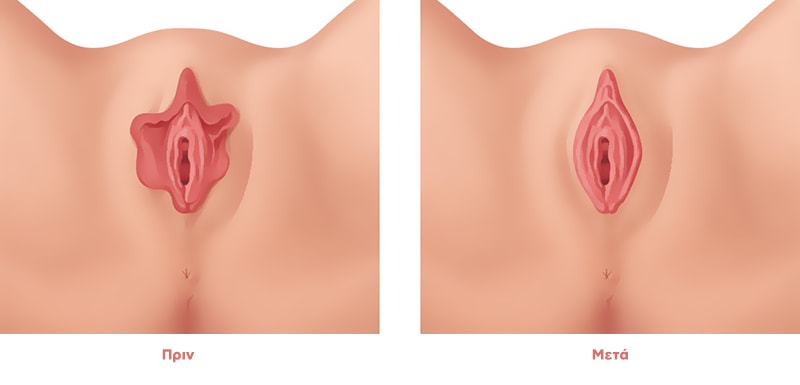
The plastic surgery procedure for correcting the labia minora is the most common procedure for the aesthetic correction of the external female genital organs.
Vulvoplasty of the Labia Minora. Where is it performed?
Plastic surgery of the labia minora is a simple routine procedure that is truly performed without significant discomfort. It can be performed in the clinic under local anesthesia or in an organized surgical clinic with a combination of local anesthesia and sedation. Return home is immediate and an overnight stay in the clinic is not required, while recovery is quite easy.
Vulvoplasty of the Labia Minora. How is it performed?
The vulvoplasty procedure is performed by removing the excess skin and mucosa of the labia minora that protrudes in an unsightly way. Removal is performed through small and well-hidden incisions parallel to the labia majora, so as to reduce the size of the labia minora. The shape of the excision incision varies depending on the case, while the procedure does not affect the sensitivity of the area in any way.
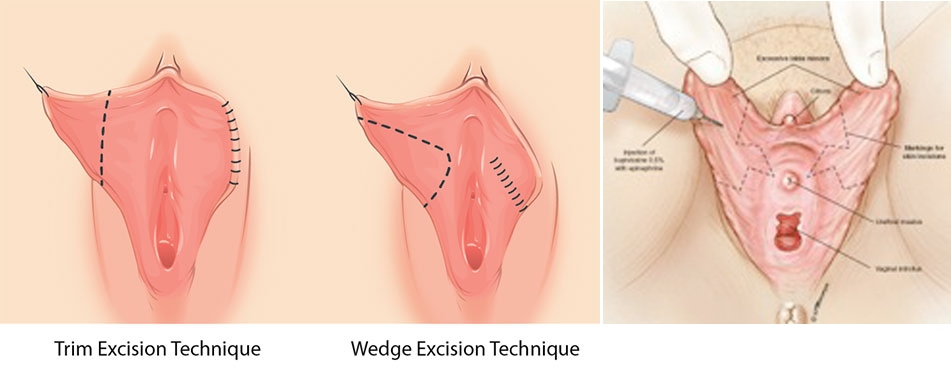
For the procedure, we use special absorbable sutures that fall out on their own after fifteen to twenty days, and therefore do not need to be removed postoperatively.
Another alternative technique, which is a considerably milder approach, is laser vulvoplasty; however, it is not indicated in all cases. The intervention is performed with a special diode laser, which can achieve tightening and reduction of the labia minora or vagina without requiring incisions and sutures. However, it cannot treat very extensive problems, since excess skin or tissue cannot be removed with this method.
Vulvoplasty of the Labia Minora. What should I do after the procedure?
Recovery after the procedure is not particularly time-consuming and return to sexual life can usually take place after two or three weeks. Pain is almost nonexistent or very mild and is treated with simple painkillers. As mentioned, the sutures are absorbable and therefore do not need to be removed.
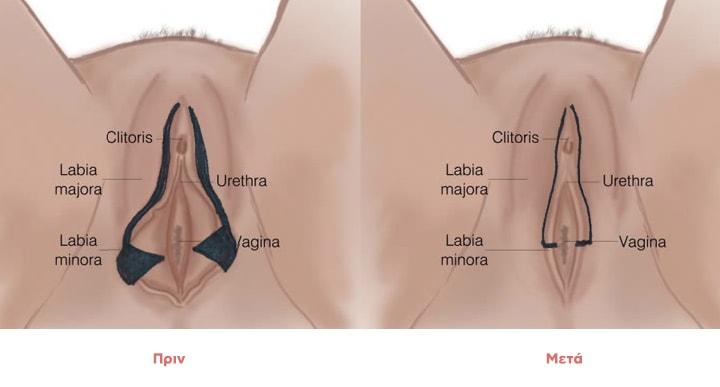
As with every surgical procedure, relative caution and moderation in activities are always recommended during the first postoperative days. It is very important to emphasize that vulvoplasty is quick, safe, almost painless, that sensitivity in the area is not affected in any way and that sexual desire increases significantly.
Vulvoplasty of the Labia Majora.
Our goal with plastic surgery of the labia majora is to achieve a more youthful appearance of the intimate area, whether the woman is wearing underwear or not. Using modern surgical techniques, we manage to “rejuvenate” the genital area without leaving visible signs of surgery postoperatively.
Plastic surgery of the labia majora concerns the folds of skin that extend from the mons pubis to the level of the anus and are located on the right and left side of the vaginal entrance, on the outer side of the labia minora.
The labia majora function as a protective gate, “closing” the vaginal entrance and, together with the labia minora, preventing microbes from entering it. At the same time, the labia majora protect against injuries, as they contain protective fat.
Many times, especially after frequent weight fluctuations or with age, the labia majora become lax and the skin “hangs” and wrinkles, resulting in the genital area appearing “aged”. There are also several women who, due to anatomical particularities, present moderate to very severe hypertrophy of the labia majora from a young age.
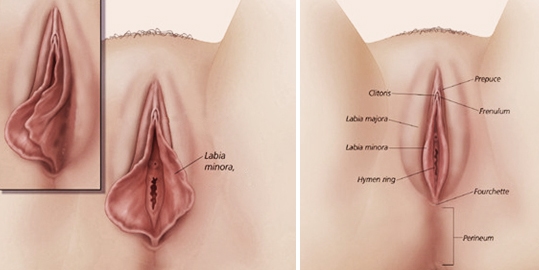
This appearance of the external genital organs, with hypertrophy of the labia majora, laxity, folds, deep wrinkles or skin creases, often resembles the appearance of a woman older than her actual age, something that reinforces insecurity and feelings of low self-esteem.
Many times in the clinic, we hear women’s concerns, anxiety and fear regarding rejection by their sexual partner when they believe that the appearance of their external genital organs is not attractive enough.
Vulvoplasty of the labia majora comes to restore this insecurity.
Vulvoplasty of the Labia Majora. Where is it performed?
Plastic surgery of the labia majora is performed in an organized surgical clinic, usually under local anesthesia or with a combination of local anesthesia and sedation. In some cases where a more specialized surgical technique is required, general anesthesia may be necessary. It is a procedure that usually lasts from forty-five minutes to one and a half hours.
Vulvoplasty of the Labia Majora. How is it performed?
The choice of technique depends mainly on the type of existing problem and the wishes of each woman individually. The procedure is very safe and almost painless while it is being performed.
During the procedure, excess skin and tissue usually need to be removed in order to reduce the size of the labia majora and give the area a firmer appearance. In some cases, however, when there are many wrinkles caused by atrophy of the labia, the solution is fat grafting into the body of the labia in order to restore their firmness and make them look more youthful.
The incisions during vulvoplasty are extremely fine and are made in the natural folds of the vulva, where they remain essentially invisible. The removal of excess skin and tissue does not affect the sensitivity of the area in any way and simply greatly improves its shape.
Vulvoplasty of the Labia Majora. What should I do after the procedure?
Recovery is easy and almost painless, as there is usually nothing more than mild discomfort in the area, which is treated with common painkillers. In some cases, mild swelling or small bruises may appear, but these subside quickly within a few days. Immediately after the procedure, we apply cool chamomile compresses to the area, as chamomile has soothing and anti-swelling properties. For the following days, we recommend regular washing of the area with mild antiseptics. No abstinence from daily activities is required, apart of course from intense exercise, which should be avoided for a few days. Regarding the final result, it is very impressive that in most cases the scars are very difficult to identify after three or four months, while women’s confidence and sexual desire increase significantly after vulvoplasty.
Complications after Vulvoplasty.
Plastic surgery of the labia majora is a very safe and almost painless procedure in the hands of a specialized Plastic Surgeon.
Its complication rate is extremely low, usually below 1%. The most common complications are hematoma and inflammation or infection of the area.
With antibiotic protection and proper hygiene of the area, the possibility of infection is extremely low.
Swelling and bruising are events that may follow this plastic procedure, but they resolve quickly over the following days without problems.
Advantages of Vulvoplasty.
The advantages of vulvoplasty are that:
- it dramatically increases the patient’s confidence, as it immediately solves the problem
- it is not painful
- it is quick, usually requiring 45 minutes to one and a half hours
- it leaves no visible scars or marks
- it has a quick recovery
- it has a low complication rate
- it has a high degree of satisfaction for both patient and doctor.
Clitoral Surgery
It may seem strange, but the clitoris is also an area that the Plastic Surgeon is often called upon to improve, mainly for practical reasons related to pleasure during sexual intercourse.
The clitoris is located at the entrance of the female vagina, just above the urethra and below the lower part of the mons pubis. It resembles a small penis, protected within folds of skin that “embrace” it, and plays a primary role in female orgasm during sexual intercourse, when the orgasm is clitoral and not vaginal.
When the skin surrounding the clitoris is thick or protrudes more prominently around it, it may create an unattractive appearance of the vulva or cause reduced sensitivity, which interferes with sexual arousal and pleasure during intercourse.
Clitoral surgery is a Plastic Surgery technique through which the existing excess skin is reduced and both the aesthetic appearance and the sensitivity of the clitoris during intercourse are restored.
- The entire procedure is performed in an organized surgical clinic, usually under local anesthesia, and does not last more than 60 minutes.
- Recovery after clitoroplasty is short and almost painless, as there is usually nothing more than mild discomfort in the area, which is treated with common painkillers.
- Rarely, mild swelling or slight bruising may occur in the area, but these subside immediately.
- Sutures do not need to be removed after the procedure, because we use special absorbable sutures that fall out after fifteen to twenty days.
- Apart from intense exercise, which should be avoided for a few days, clitoral surgery does not require abstinence from daily activities.
- Clitoral surgery is a very safe procedure in the hands of an experienced Plastic Surgeon, without significant complications.
Mons Pubis Surgery
The mons pubis is the suprapubic area, meaning the bikini area. When the mons pubis does not have the desired appearance, especially in the modern era where almost complete hair removal of the area is the rule rather than the exception, this may affect a woman’s psychology and make her feel ashamed of her body when naked or when wearing light clothing, especially in summer. The most common problem observed in the mons pubis area is increased localized fat deposition, resulting in the bikini area “bulging” and protruding unattractively through tight clothing, underwear and swimsuits. It is also quite common, especially after pregnancies or major weight fluctuations, for this area to present significant laxity, resulting in the skin protruding and “hanging” over the vulvar area.
Mons pubis surgery is a Plastic Surgery procedure that aims to restore the anatomy of the suprapubic area and give it a more youthful, firmer and more natural appearance.
This is achieved by removing excess fat from the bikini area through mini liposuction in the area, while if required, excess skin may also be removed so that the mons pubis acquires a firmer and more youthful appearance.
- Mons pubis surgery is usually performed in a clinic under local anesthesia or a combination of local anesthesia and sedation.
- Return home is immediate and an overnight stay in the clinic is not required, while recovery is quite easy.
- There is usually no pain, only mild altered sensation that subsides within a few days and is treated with simple painkillers.
- Mild swelling or bruising may appear after the procedure, but these subside and disappear after approximately one week.
The mark from mini liposuction is extremely tiny and usually is not visible after a few months. If excess skin removal is required, then the incision is very fine and usually resembles a caesarean-section incision placed lower.
Return to daily activities is immediate and recovery is quick, usually without complications or adverse events.
Perineal Surgery
The perineum is the area that extends from the vagina to the woman’s anus. It is an area that is often “traumatized” during natural childbirth, either due to poor suturing or due to tearing during childbirth in cases where the well-known incision by the obstetrician has not been performed. The perineal area often becomes lax after repeated births, resulting in a loose appearance of the genital area, something that makes the woman feel truly uncomfortable.
In addition to the deformation and laxity of the perineum, many times, and often after multiple or difficult natural births, laxity of the vaginal entrance or the entire vagina may also occur. The problem in these cases is that the woman feels “loose” during sexual intercourse, resulting in greatly reduced sexual satisfaction because the vaginal walls have “weakened”. The solution to this problem of vaginal wall laxity is called vaginoplasty or vaginal surgery.
Perineal surgery is the surgical procedure that aims to aesthetically restore the area and increase the tension of the skin and tissues at the entrance of the vagina. In cases where perineal surgery is performed to correct vaginal laxity, it is usually combined with vaginoplasty, in order to achieve tightening along the entire length of the vagina. This procedure manages to correct both the aesthetic problem of a deformed perineum and the functional problem of vaginal laxity.
The scar that may exist in this specific procedure is a very fine line along the perineum, which after some time will be practically almost invisible, while the scar inside the vagina is not even noticeable.
- Perineoplasty is performed in an organized clinic, usually under general anesthesia or under local anesthesia combined with sedation.
- The duration of the procedure does not exceed 60 minutes and return home is immediate, while recovery is quite easy.
- There is usually no pain, or it is mild and treated with simple painkillers.
- Immediately after the procedure, good hygiene of the area is recommended, with regular washing using an antiseptic solution and moderate restriction of activities during the first postoperative days.
- Perineal surgery is one of the safest procedures, without significant risks or complications.
Hymenoplasty
Hymenoplasty is the suturing of the hymen after its rupture.
The hymen is a very thin membrane that covers the entrance to the female vagina. Its purpose is to protect the vagina and cervix from microbes, so that the young girl is not affected by vaginitis during development.
The hymen usually breaks during first sexual intercourse, something that is accompanied by momentary pain and the presence of a small amount of blood. As the years pass, the hymen dissolves and only small parts of it remain.
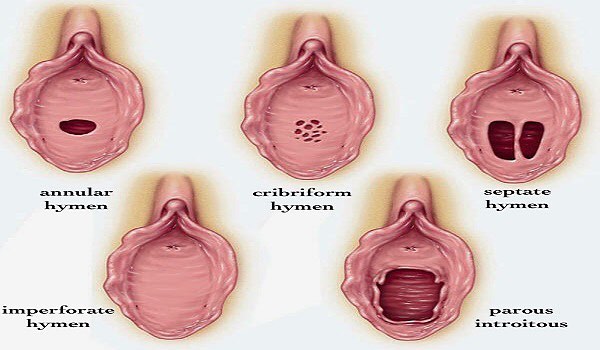
There are cases where the hymen may break even without sexual intercourse, for example after an injury, as well as cases where it may not break after intercourse.
The most common reasons for a woman to undergo hymenoplasty are predominantly social or religious.
Mainly in the past, but also today in various societies or traditions, the issue of honor is associated with the gift of virginity. If a woman is not a virgin, then issues of dignity may arise that could, for example, lead to the cancellation of a relationship or marriage. Also, after rape or a failed relationship, a woman may wish to restore the area in order to erase the signs that remind her of the unpleasant experience.
The procedure for restoring the “broken” hymen, as already mentioned, is called hymenoplasty. It is usually performed under local anesthesia in the clinic or in a surgical clinic and requires only a short stay. During the procedure, special absorbable sutures are used, which completely restore the continuity of the hymen and do not need to be removed. After hymenoplasty, in most cases there are no marks or scars and the hymen appears intact.
If a woman has sexual intercourse after hymenoplasty, it is as if she is having intercourse exactly like the first time. The hymen will break, there will probably be momentary pain and a small amount of blood. With hymenoplasty, along with the integrity of the hymen, the woman’s confidence is often restored and issues of honor and dignity are resolved… quietly.
Aesthetic and functional problems in the intimate area find their solution through specialized and delicate Plastic Surgery procedures.
Respecting policies regarding adult-only content, we cannot show you real photographic material on this page. However, we would be happy to show you material with the results of our procedures by email, if you contact us at: [email protected]