
Rhinoplasty
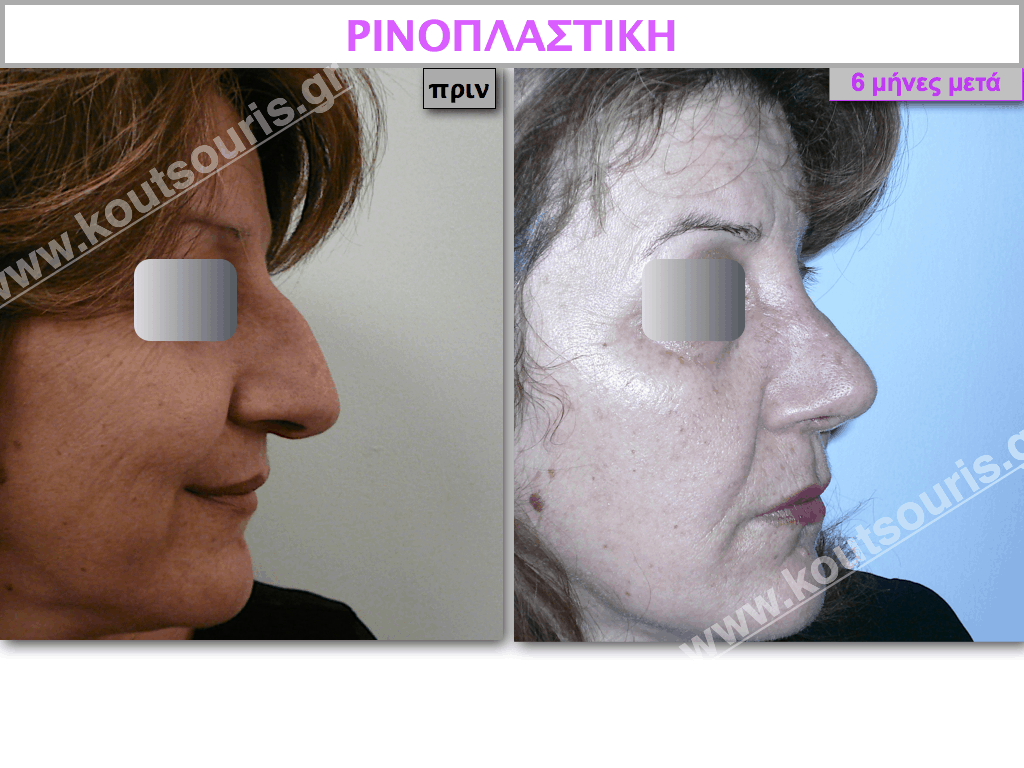
The surgical procedure used to correct or restore imperfections of the nose is called rhinoplasty or nose surgery. It is one of the most popular Plastic Surgery procedures, as it accounts for 80% of aesthetic procedures involving the face. More specifically, it is the second most popular surgical procedure worldwide, after liposuction. It is worth noting that in Greece, rhinoplasty procedures have increased by 35% over the past five years, as they are performed not only for aesthetic reasons but also for purely functional purposes.
Our primary goal during rhinoplasty is to create a nose that:
- allows the patient to breathe properly,
- is aesthetically pleasing,
- is in complete harmony with the remaining facial features and, most importantly,
- does not appear to have been surgically altered.
What is the importance of the nose for the human body?
The nose is one of the most important organs of the human body because:
- it is located at the center of the face, meaning that its shape and size play a primary role in the harmony and aesthetics of the facial features.
- it is responsible for nasal breathing, meaning the passage of air through the airways to and from the lungs.
- it plays an important role in filtering inhaled air and removing dust, pollen, microparticles, etc.
- it is responsible for the sense of smell, one of the body’s five primary senses, and
- it plays a key role in regulating the temperature and humidity of inhaled air during breathing.
What are the main anatomical characteristics of the nose?
The nose is located precisely at the center of the face and, apart from being a key aesthetic feature, it is the primary organ of breathing. It could be compared to a pyramid divided into two compartments by a vertical partition that runs lengthwise through its center. These compartments are called the nasal cavities, and the vertical partition is called the septum.
The two nasal cavities are the airways through which air passes during inhalation and exhalation. The inferior nasal turbinates project from the base of each cavity, one on the right and one on the left. These are bony and mucosal structures that protrude like small “balconies” at the base of each nasal cavity, and their purpose is to humidify the air during breathing.
The vertical partition that divides the nasal cavities is made of bone in its upper third, while the remaining part consists of cartilage and is called the nasal septum. The septum supports the roof of the nose internally, functioning as an internal pillar and resting on the bone of the upper jaw at a point called the nasal spine.
The entire framework of this pyramid-shaped structure is covered internally by mucosa and externally by skin. It forms a distinctive anatomical complex, as it provides aesthetic balance to the face while also being responsible for the proper function of breathing.
Who is rhinoplasty suitable for?
It is very important to emphasize that rhinoplasty is a procedure that treats nasal deformities related to aesthetics, such as:
- a misshapen, wide or asymmetrical nasal tip,
- the presence of a large dorsal hump,
- a crooked nose,
- wide nostrils,
- and, in general, abnormalities of the bony and cartilaginous framework of the nose.
At the same time, alongside cosmetic nose surgery, we can also treat purely functional nasal problems, such as:
- deviation of the nasal septum, meaning a crooked septum,
- hypertrophic nasal turbinates,
- the nasal spine,
- nasal valve dysfunction.
These are anatomical problems of the nose that may be responsible for serious medical conditions, such as sinusitis, headaches, tonsillitis, ear infections, etc. These problems often trouble patients for many years, and their primary cause is difficulty breathing.
What happens in practice when someone has difficulty breathing through the nose?
Nasal breathing is a complex process, and when it is impaired, the problem is much more often caused by a combination of factors rather than by a single isolated cause.
When someone experiences difficulty breathing through the nose, the problem may be caused by:
- a crooked or deviated nasal septum
- enlarged or hypertrophic nasal turbinates
- an abnormal position of the septum in relation to the nasal spine
- nasal valve dysfunction.
What happens to breathing when there is a deviated nasal septum?
When someone suffers from a deviated nasal septum, meaning they have a crooked septum, they cannot breathe properly through the nasal cavity located on the side toward which the septum deviates. This happens because the curvature, mainly of the cartilaginous section of the septum, narrows the airway and makes breathing difficult.
In this case, theoretically, nasal breathing takes place normally through the other, larger nasal cavity. In practice, however, it is not uncommon for a deviated nasal septum to cause the paradoxical situation in which breathing is impaired through both nasal cavities at the same time.
This occurs because, when the septum is crooked, the passage in the nasal cavity that is “closed” by the deviated septum becomes narrow and air cannot pass through easily. At the same time, air may also have difficulty passing through the larger nasal cavity because the inferior nasal turbinate is often hypertrophic. The inferior nasal turbinate on the non-deviated side enlarges and blocks the airway, thereby obstructing breathing.
Apart from a crooked septum, what other factors may obstruct normal breathing?
Very often, apart from a deviated nasal septum or hypertrophic turbinates, difficulty breathing may also involve the presence of a nasal spine located in an abnormal position in relation to the septum, as well as nasal valve dysfunction, which restricts the passage of air through the airway.
These are two anatomical problems of the nasal airways that occur less frequently, either independently or alongside septal deviation or hypertrophic turbinates.
How is rhinoplasty performed?
Depending on where the nasal problem is located and whether breathing difficulty is present, rhinoplasty may be performed using three different techniques:
- the closed technique
- the open technique, and
- the “semi-closed” technique, which is a modified combination of the two previous methods.
Closed or Endonasal Rhinoplasty
During closed rhinoplasty, the procedure is performed through almost invisible incisions made inside the nostrils. With this technique, there are no external incisions on the skin. It is the preferred method in up to 70% of all rhinoplasty procedures, as it can provide an excellent result in terms of both aesthetics and nasal function.
The closed technique is usually recommended for rhinoplasty procedures of low to moderate complexity, such as noses with a prominent dorsal hump or when small changes to the nasal tip are required.
This technique requires an in-depth knowledge of the anatomy of the nasal framework, as well as strong three-dimensional surgical perception, because the procedure is effectively “blind”. The surgeon does not have direct visibility of all elements of the nasal framework and must therefore visualize the position of the structural tissues beneath the skin.
The closed technique is essentially performed through two small openings created inside the nostrils. The entire procedure is performed and guided through direct vision combined with the surgeon’s sense of touch when handling the nasal tissues. Through these incisions, the tissues are redistributed and the nasal framework is reshaped.
With the closed technique, the absence of a wide and clear visual field often makes the surgeon’s work more difficult and the procedure more complex, involving numerous technical details and specialized techniques. This is one of the reasons why many Plastic Surgeons choose open rhinoplasty. Nevertheless, the major advantage of the invisible incisions placed inside the nasal cavities makes it an excellent technique.
Open Rhinoplasty
Open rhinoplasty can be applied to all patients who wish to undergo nose surgery. Furthermore, it can be considered the preferred technique for all rhinoplasty procedures of moderate to high complexity.
The open rhinoplasty procedure usually begins with a small L-shaped incision on the columella of the nose. The initial incision is then connected to incisions made on the inner surface of the nostrils, followed by the separation of the entire nasal skin from the underlying tissues.
In this way, the bony and cartilaginous framework becomes clearly visible, including all of its elements, such as the alar cartilages, septum and nasal bones. This approach gives the surgeon direct visibility of the entire anatomy and pathology of the nose.
Using the excellent exposure of the nasal framework provided by open rhinoplasty, we can identify the abnormal areas of the framework and correct them directly.
In recent years, various techniques have been developed, such as the placement of grafts at the nasal tip, known as tip grafts, or in the columella, known as strut grafts, as well as cartilage-resuturing techniques. These can be performed with greater precision during open rhinoplasty because of the improved visual field that is achieved.
“Semi-Closed” Rhinoplasty
“Semi-closed” rhinoplasty is an excellent surgical technique that combines the advantages of the two previous methods.
As with the closed technique, the skin incisions in semi-closed rhinoplasty are almost invisible, as they are placed inside the nasal cavities along their lower border.
On the other hand, by using the access incisions and applying appropriate surgical techniques, we achieve greater exposure of the nasal framework, similar to that achieved during open rhinoplasty. In this way, we have greater direct visual access to the problematic nasal framework and can restore it more easily.
“Semi-closed” rhinoplasty is an intelligent, relatively safe and technically quick technique that provides a solution primarily for problems involving the nasal tip, as well as for rhinoplasty procedures of moderate complexity.
It must be strongly emphasized that whenever rhinoplasty is performed, we must restore or avoid disrupting the normal function of the nose. For this reason, alongside aesthetic correction, we very often also correct a deviated nasal septum, reduce the volume of the inferior nasal turbinates or restore the position of the nasal spine.
Our primary priority is for the patient to breathe better after surgery while having a harmonious and natural-looking nose.
How long does rhinoplasty take?
The procedure lasts approximately one and a half to two hours, and an overnight hospital stay is usually required. For rhinoplasty procedures of low to moderate complexity, when osteotomies are not performed to correct the nasal pyramid or when the nasal septum is not altered, an overnight stay in the clinic is not required.
Is rhinoplasty painful?
It is remarkable that there is usually no pain at all after rhinoplasty. In very rare cases, there may only be discomfort or mild pain, which can easily be managed with simple painkillers. More specifically, patients who have undergone nose surgery often describe that “it does not hurt”, but that they “feel moderate discomfort”. This discomfort is caused by swelling, which often appears in the area and may be accompanied by bruising around the eyes, leading many people to believe that the patient is in pain. In reality, however, this is not the case.
What will I be like immediately after rhinoplasty?
After rhinoplasty, a special thermoplastic splint is placed on the bridge of the nose, while two special nasal packs are inserted inside the nose, one in each nasal cavity. The splint and nasal packs are used to stabilize the nasal framework in its new position.
The nasal packs are removed after three days, while the splint is removed after approximately one week. After the nasal packs are removed from the nasal cavities, the patient may feel for a few days as though the nose is blocked, similar to having a mild cold. In general, after rhinoplasty, there is swelling of the face and bruising, mainly around and beneath the eyes. The swelling and bruising are most pronounced during the first two to three days. Toward the end of the week, the bruising around the eyes gradually begins to disappear.
The patient can go out after the third or fourth day while wearing the special protective nasal splint. After the seventh day, when the splint is removed, the patient can move around more freely. A return to work is usually possible after approximately five to seven days.
Should I take any precautions after rhinoplasty?
Because the tissues are very sensitive after surgery, care must be taken to avoid injury to the nasal area immediately after the procedure and for the following three to four months.
We recommend antibiotic treatment for one week, as well as periodic nasal rinsing with saline solution and the application of nasal ointment for approximately ten to fifteen days.
Immediately after surgery, the nose is swollen, and this swelling gradually subsides over the following months. To help reduce the swelling more quickly, we often recommend gentle massage in the direction from the nasal tip toward the glabella.
When will the result of rhinoplasty be visible?
The nose is quite swollen after surgery. However, an initial assessment of the result can be made after two to three weeks.
As time passes, the swelling subsides slowly but steadily, and the appearance of the framework and the nasal features becomes clearer. We can therefore say that, in most rhinoplasty cases, approximately twelve to eighteen months are required before the final result is achieved.
What are the complications of rhinoplasty procedures?
Rhinoplasty is a highly sophisticated procedure and requires respect for the fundamental principles of surgery. Whether performed using the closed, open or semi-closed technique, it must be carried out with great care and with gentle, precise techniques so that complications are minimized and the result is as harmonious as possible in relation to the facial features.
The main complications mentioned in the medical literature are:
- inflammation
- bleeding, usually immediately after surgery
- impaired breathing function
- aesthetic deformity of the nasal tip, bridge or nasal framework in general.
We must keep in mind that during rhinoplasty, we are required to correct the aesthetic problem of the nose while respecting its breathing function. For this reason, we operate on the cartilaginous and bony nasal framework, alter the shape and position of the cartilages, improve breathing and ultimately correct the shape of the nose.
It is therefore a complex procedure involving many parameters and requiring a significant amount of time before it is fully completed.
The degree of skin contraction, as well as the speed and manner in which each patient’s tissues heal, plays a very important role, together with the surgical technique, in achieving the desired final result.
Can rhinoplasty be combined with another procedure?
Rhinoplasty may be combined with procedures that improve the harmony of the facial features.
Such procedures include:
- chin augmentation or reduction
- correction of dark circles beneath the eyes
- correction of the shape and size of the lips, and
- otoplasty.
By correcting the size and shape of the nose, we take a very important step toward improving facial aesthetics. However, by correcting the size of the chin, the hollows beneath the eyes, the lips or the position and shape of the ears, we can achieve excellent harmony among all the facial features.
Chin reduction and otoplasty are performed strictly using surgical techniques. Regarding the correction of dark circles beneath the eyes and the shape of the lips, the modern trend today is to perform the correction using injectable Hyaluronic Acid
What is the desired result of rhinoplasty?
The nose is located precisely at the center of the face and is directly connected to the remaining facial features.
The modern trend in rhinoplasty is not the “French-style” nose, meaning a thin nose with an upturned tip, but rather a nose that sits harmoniously among the facial features.
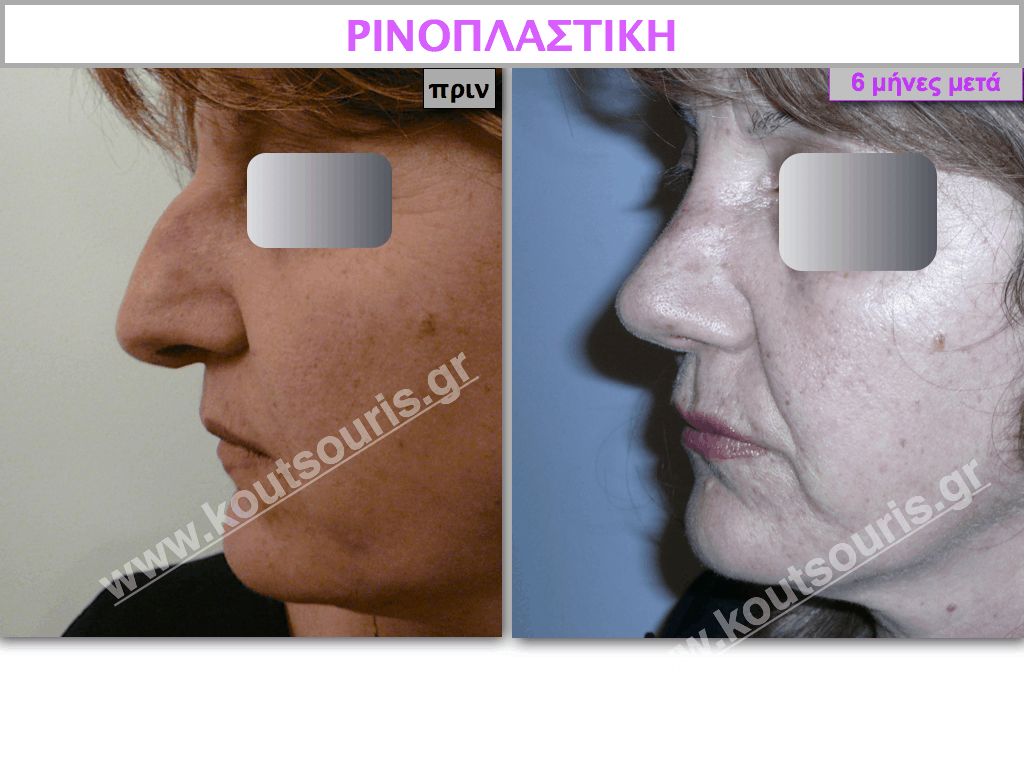
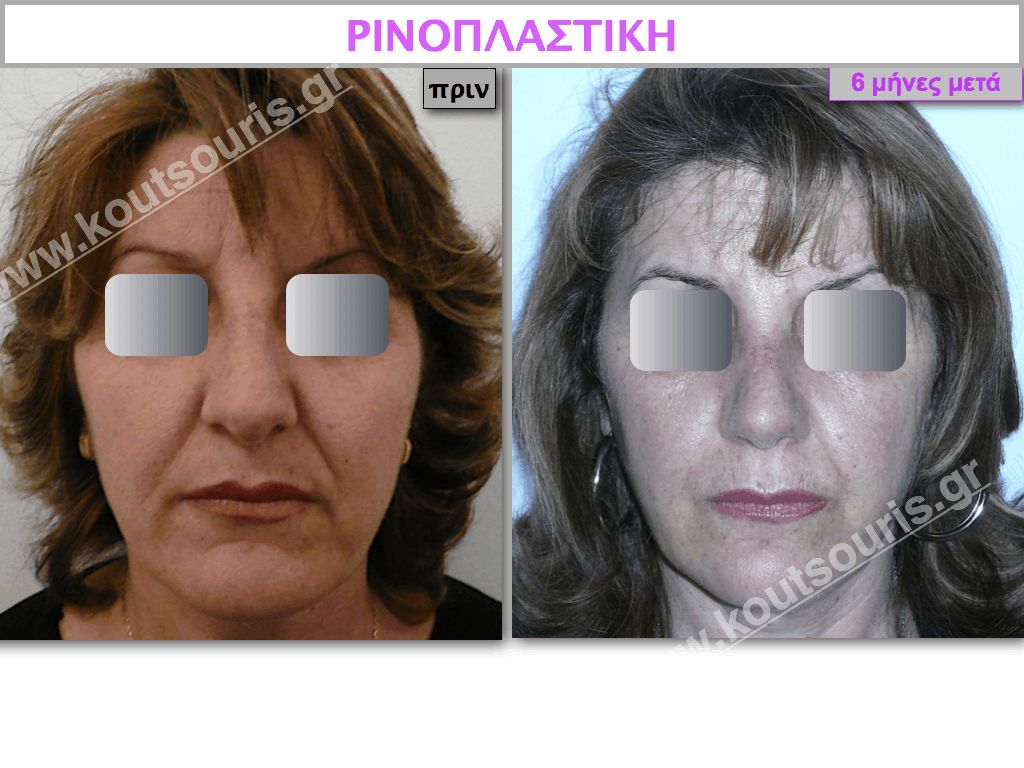
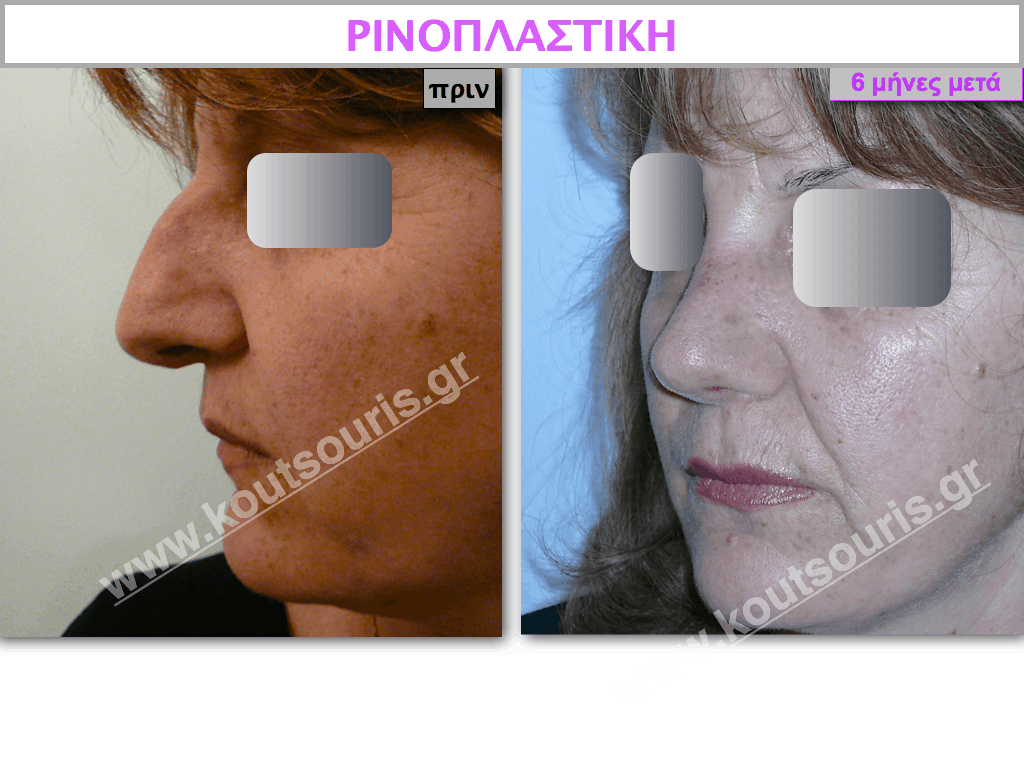
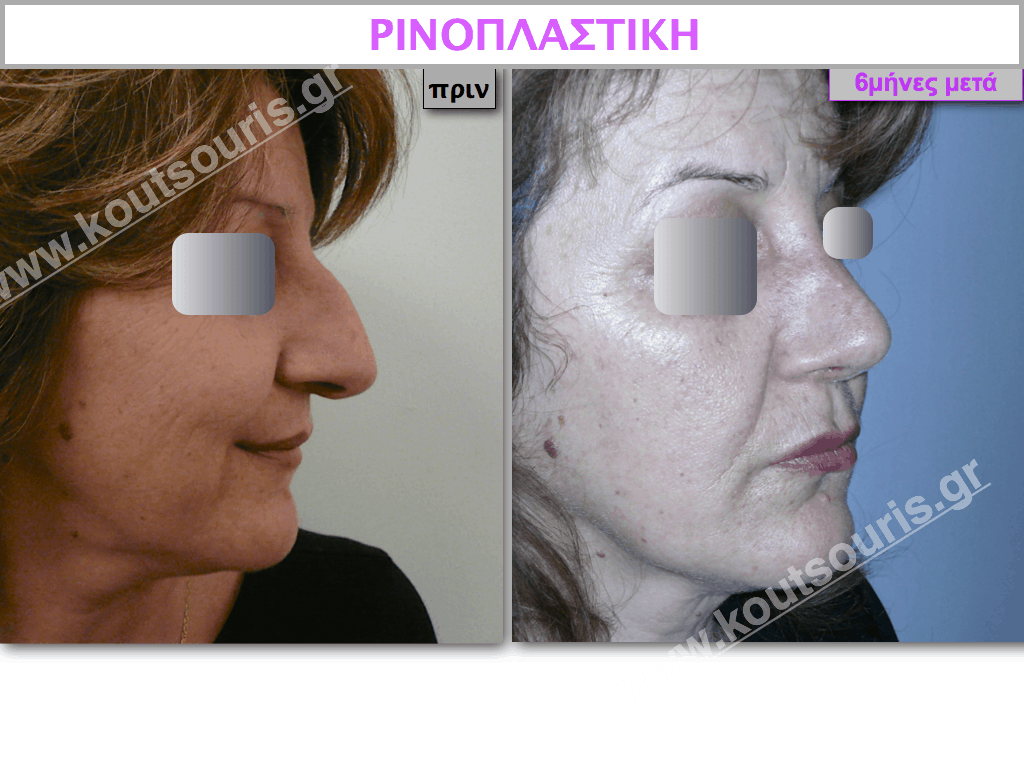
A rhinoplasty procedure is considered successful when the “new” nose:
- looks completely natural and does not appear artificial
- has a size and shape that follow the principles of harmony
- allows the patient to breathe and smell properly
- produces an aesthetically pleasing overall result
- does not reveal that the patient has undergone surgery.
The above article was reviewed by Dr. Michalis Koutsouris, who personally reads every message he receives and will respond to you promptly. (4 Merlin Street, Kolonaki – Tel.: 216 800 1000)